
SunshineCTF '26 - Homemaker writeup
Homemaker Challenge Writeup
Buckle up as I walk you through my process of discovery and how I cracked the many parts of this challenge. The writeup is best followed with IDA Pro open in another window. A good ~70% of this challenge is reversing the binary.
Challenge prompt
# A SERVANT IN EVERY HOME, BY 1975!

APEX ATOMIC HOUSEHOLD INDUSTRIES, INC IS PROUD TO ANNOUNCE THE MODEL 7 "HOMEMAKER" DOMESTIC AUTOMATON

POWERED THROUGH USE OF PUNCH CARDS, THE MODEL 7 IS EQUIPPED WITH THOUSANDS OF BYTES OF MEMORY!

THE FUTURE IS HERE, NOW!
Chapters
1. Initial observations
Upon first running, the program prints out a cute ASCII art and then waits for 4 characters of input. The program exits after 4 characters have been provided. Presumably, we need to provide a certain input that will prompt the program to accept more input. Time to decompile!
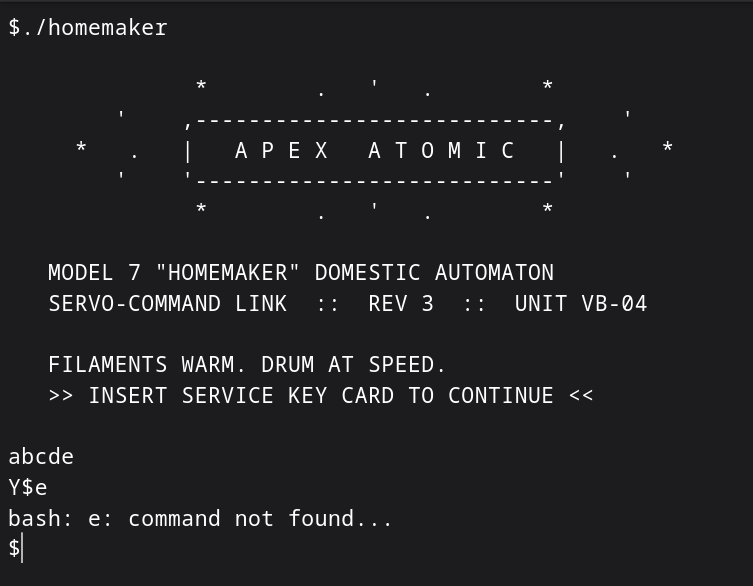
Opening up IDA Pro, we identify that main() calls sub1865() and does nothing else. Thus, we can rename sub1865() to main_(). `

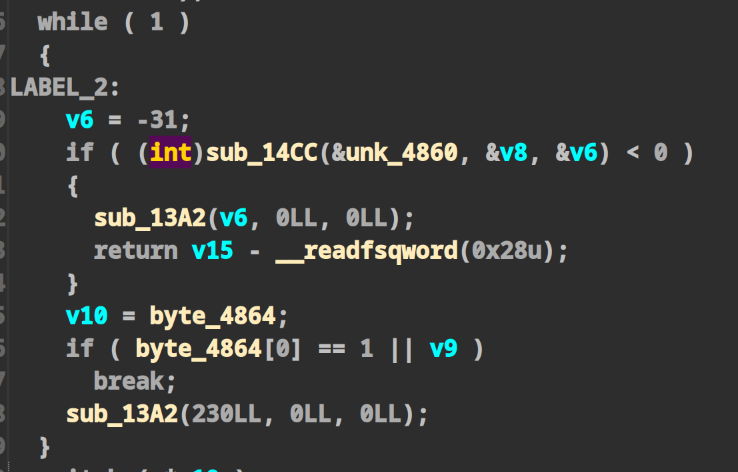
main_() prints out the ASCII art and subsequently initiates a while loop. The while loop is only broken out of when byte_4864 of the elf is set to 1 or when v5 is set to 1. v5 is initialized to 0 earlier in the function, so the first command must set byte_4864 to 1.
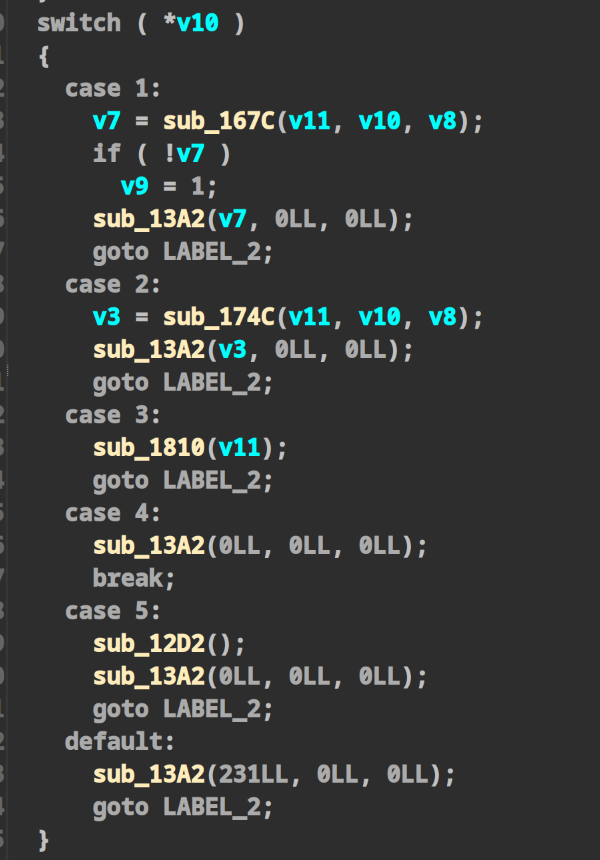
Upon exiting the while loop, we are faced with a switch statement where each case calls further functions. This made me think of a VM executing opcodes. Let's rename v10 to opcode. Given that this is a pwn challenge and not a rev challenge, we can presume that some of these functions are useful for manipulating the stack or the heap.
2. The header
Now let's figure out how the program takes input. The first function called in the while loop is sub_14CC() so let's start there. It resides in an if statement. If sub_14CC() returns a negative value, sub_13A2() is executed and we then return. Therefore, we want sub_14CC() to return a positive value so we can avoid returning out of main_(). sub_14CC()'s first argument is a pointer to unk_4860, a section of the ELF's .bss . This is a 2048-byte buffer, thus we rename unk_4860 to bss_buffer. We also notice that byte_4864 is 5 bytes into this buffer. This might be useful later.
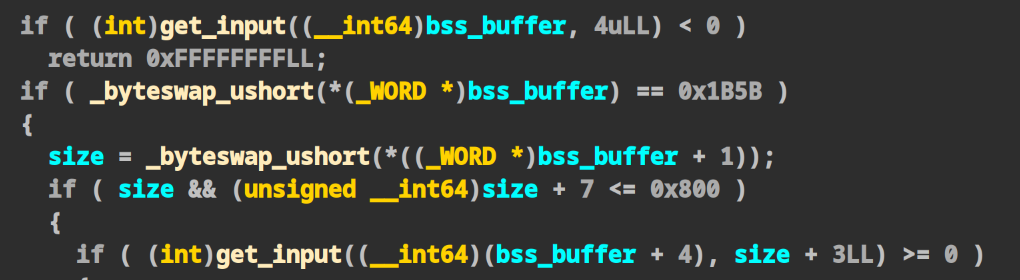
Digging further into sub_14CC(), sub_1313() is immediately called with the bss_buffer and the integer 4 as arguments. sub_1313() continuously reads into the buffer until it has read 4 bytes of input. Therefore, let's rename sub_1313() to get_input(). As long as some bytes are read in by get_input(), it will return 0 and we will pass the first conditional in sub_14CC(). The next conditional checks if the first two bytes provided are 0x1B5B. The byte swap was graciously placed there to simplify our lives as it relates to endianness; thus the byteswap can effectively be ignored. Since this check is run on every input, we know that we must always prepend 0x1B5B to every input we send. This acts like a magic byte or header. Next, v6 is a 16 bit integer containing bytes 2 and 3 of our input. An if statement checks that bytes 2 and 3 are not zeros and that the value is <= 0x7F9. Now is where things get juicy. get_input() is run again, this time taking in v6 + 3 in the size field. let's rename v6 to size. We can now piece together that every command must start with \x1B\x5B<2_byte_size>. Then, a size number of bytes are gathered from stdin. Critically, this input is also placed in the bss_buffer, following the four header bytes we just sent.
3. The footer
The last function to get called in sub_14CC() is sub_11E9(). sub_11E9() takes as input the bss_buffer right after the header. sub_11E9() does a whole lot of operations. The most important piece to identify here is that every byte of unique input gets processed and a single byte is returned. It follows that sub_11E9() computes a checksum and is renamed as such. Back in sub_14CC the result of checksum() is then compared to v4, which is the third-to-last byte of the bss_buffer. checksum() can be directly reimplemented in our solve script.
Checksum implementation
= 0
= & 0xFF
= & 0xFF
= & 0xFF
=
return
The very last conditional in sub_14CC() looks complicated but is essentially a fancy way to check that the last two bytes provided are 0x1B5C. If this confuses you, pause here and trace out what happens to the individual bits on a sheet of paper.

Packet format
We now have all the information needed to piece together the format needed for all our inputs. Furthermore, we can now rename sub_14CC() to recv_input(). If we do the dance correctly, recv_input() will place the size value in a2. Since a2 is a pointer taken in as an argument, we rename a2 and v8 in main_() to size.
\x1B\x5B
<2_byte_size>
<opcode>
[payload]
<checksum>
\x1B\x5C
4. Authentication
Going back to main_(), we are now able to pass the first if statement of the while loop. We know that byte_4864 (the first byte of our payload) needs to be 1 to break out of the while loop, so let's set payload = b"\x01".
Next, the same byte of our payload is used as the opcode in the switch statement. Case 1 runs two functions, with an if statement sandwiched between them. If sub_167C() returns a zero value, v9 gets set to 1, and we can bypass future authentication checks in the while loop. In simpler terms, if we authenticate once successfully, we don't have to authenticate again. let's rename v9 to auth.
v11 is a 260-byte buffer on the stack so let's rename it to stack_buffer. sub_167C() takes in stack_buffer, the opcode, and the size. Within sub_167C we see that size must be set to 5 and sub_1289() takes our input as an argument. sub_1289() requires those 4 bytes to be 0x1337C35F. We rename sub_1289() to login_() and sub_167C() to login(). As long as we pass in a size of 5 and the bytes "\x13\x37\xC3\x5F", we will pass through and set auth to 1. Don't worry we'll come back to the shenanigans happening to stack_buffer later on.
The last part of case 1 is sub_13A2(), which does a whole bunch of funky stuff and then writes to stdout; so let's rename it to funky_print()
Login packet
We are now able to authenticate by sending the following payload:
\x1B\x5B
\x00\x05
\x01
\x13\x37\xC3\x5F
\x5B
\x1B\x5C
5. Reversing the functions
I hope you're still with me because so far it's only been the easy part. We now know what opcode 1 does, but how about opcodes 2, 3, 4, and 5?
sub_12D2 in case 5 executes a pointless system call. system("/bin/echo -n ''") literally prints out nothing. But a system call might enable us to execute /bin/sh. let's rename sub_12D2 to system_call().
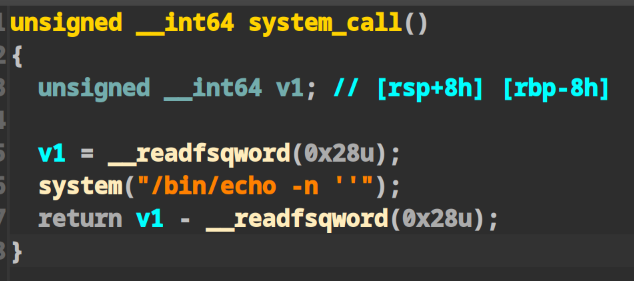
Remember stack_buffer from Chapter 4? It's back and it's better interpreted as a struct. IDA Pro automatically detects its proper format, we just have to mess around with its variables names:
stack_buffer;
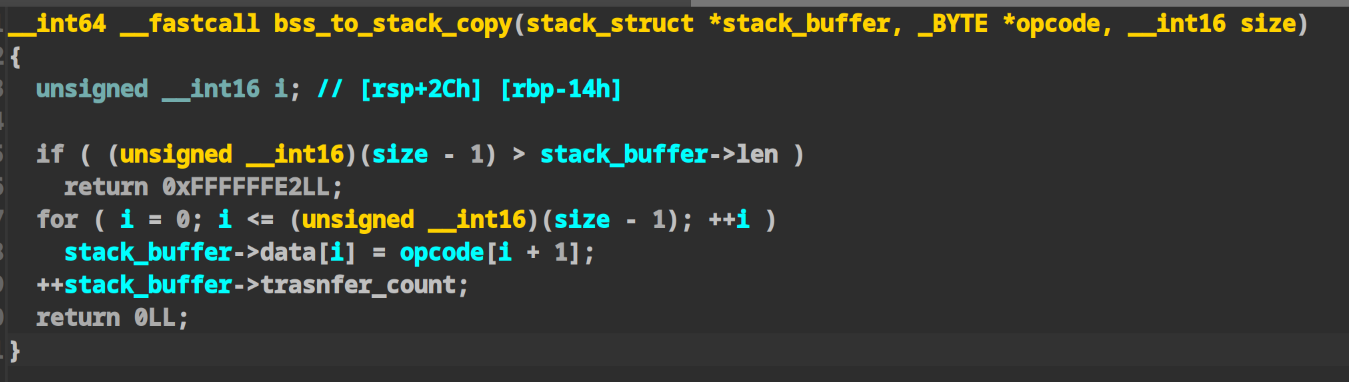
sub_174C in case 2 takes as arguments the stack_buffer, opcode, and the size of the input that was read. Here, opcode is treated as a pointer so it is best to define it as one _BYTE *opcode. This makes sense as it is a pointer into the .bss buffer that we wrote into. Within sub_174C() we can see a for loop, iterating over our payload size number of times. Every iteration, it copies from the payload into stack_buffer->data[i]. stack_buffer->transfer_count increments once for every successful opcode 2 execution. The most critical piece to take away from case 2 is that data gets copied from the .bss buffer we wrote to, into the stack. This hints towards a stack overflow vulnerability. let's rename sub_174C() to bss_to_stack_copy().
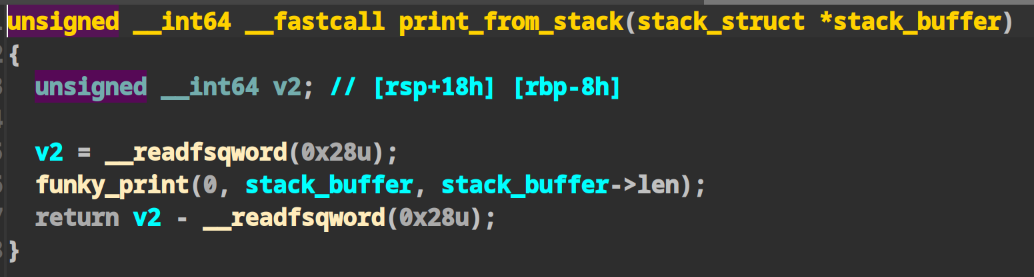
sub_1810() in case 3 acts as a wrapper for funky_print(). Most notably, it prints from stack_buffer and not the .bss buffer. This will be later useful for leaking stack addresses and the canary. let's rename sub_1810() to print_from_stack().
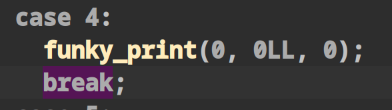
Last, case 4 is significant not because it calls funky_print() with any valuable arguments, but because it is the only opcode that ends in a break. Triggering that break leads to a return. This strongly points to a ROP exploit.
6. ROP
Now, the last major puzzle piece we need is to identify how we can overflow the stack. This part is tricky and took us a while to identify. We know for sure that the overflow must happen in bss_to_stack_copy() as it is the only location we can control where the stack is written to. login() set stack_buffer->len to 256, so any size value less than or equal to 257 will pass the first conditional. Next, because the for loop implements <= in its conditional, a size input of 257 will copy 257 bytes to stack_buffer->data. Since stack_buffer->data is of size 256, here we have our overflow.
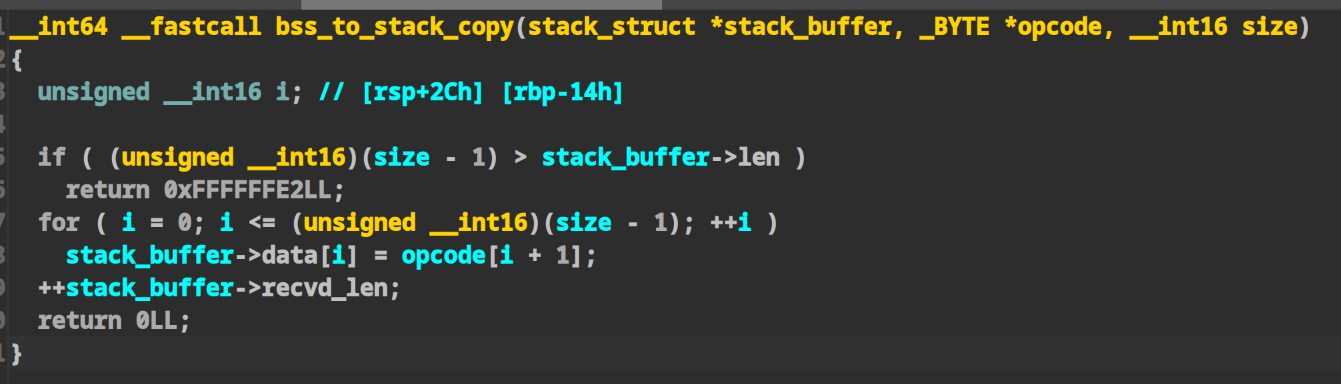
The copy starts after the opcode but copies size bytes. Thus, the checksum also gets written to stack_buffer->data overflowing onto stack_buffer->len. Because the most significant byte of stack_buffer->len is still 0x01, this allows us to set it to a much greater value. Now, print_from_stack() will allow us to print stack_buffer->len number of bytes from stack_buffer->data. By setting stack_buffer->len to 0x01e6, opcode 3 prints 486 bytes from stack_buffer->data. This leaks the canary and main_()'s return address. Now, all we need is to build a ROP chain, put "/bin/sh" at a known location in the bss_buffer, pop "/bin/sh"'s address into rdi, and call system().
Exploit script
#!/usr/bin/env python3
= 0
= & 0xFF
= & 0xFF
= & 0xFF
=
return
= b
=
= b
=
= + + + +
return
# first run - login
=
#p = remote("sunshinectf.games", 26008)
= b
# trigger vuln
= b
= b * # overwrite length
# leak stuff
= b
=
=
=
=
# ROP THE SHIT OUT OF THIS BINARY
= - 6815
=
=
= 0x12aa + #rop.find_gadget(['pop', 'rdi', 'ret'])
# put /bin/sh in .bss
= b
= b
= b * +
=
# KEEP ROPPING
= + 0x4860 + 0x500
= +
= + 1 # ret gadget
= b * 264
= + + b * 8 + + + +
= b
=
=
# exit
= b
=